
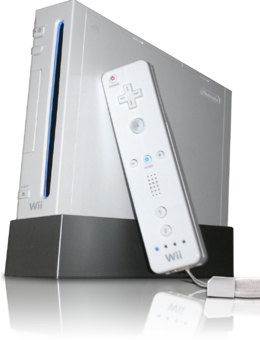
The Wii (ウィー, Uī?, pronounced /ˈwiː/, like the pronoun we) is a home video game console released by Nintendo. As a seventh-generation console, the Wii primarily competes with Microsoft's Xbox 360 and Sony's PlayStation 3. Nintendo states that its console targets a broader demographic than that of both.[6] As of December 31, 2008 the Wii leads the generation over the PlayStation 3 and Xbox 360 in worldwide sales.[1]
A distinguishing feature of the console is its wireless controller, the Wii Remote, which can be used as a handheld pointing device and detect movement in three dimensions. Another distinctive feature of the console is WiiConnect24, which enables it to receive messages and updates over the Internet while in standby mode.[7]
The Wii is Nintendo's fifth home console, the direct successor to the Nintendo GameCube, and able to play all official GameCube games. Nintendo first spoke of the console at the 2004 E3 press conference and later unveiled the system at the 2005 E3. Satoru Iwata revealed a prototype of the controller at the September 2005 Tokyo Game Show.[8] At E3 2006, the console won the first of several awards.[9] By December 8, 2006, it had completed its launch in four key markets.
Technical specifications
Nintendo has released few technical details regarding the Wii system, but some key facts have leaked through the press. Though none of these reports has been officially confirmed, they generally point to the console as being an extension or advancement of the Nintendo GameCube architecture. More specifically, the reported analyses state that the Wii is roughly 1.5 to 2 times as powerful as its predecessor.[2][88] Based on the leaked specifications, the Wii is the least powerful of the major home consoles in its generation. The Wii uses a storage system similar to the GameCube, which uses "block" units rather than bytes. The conversion from blocks to bytes is roughly 8.12 blocks to one megabyte.
Processors:
CPU: PowerPC-based "Broadway" processor, made with a 90 nm SOI CMOS process, reportedly† clocked at 729 MHz[89]
GPU: ATI "Hollywood" GPU made with a 90 nm CMOS process,[90] reportedly† clocked at 243 MHz[89]
Memory:
88 MB main memory (24 MB "internal" 1T-SRAM integrated into graphics package, 64 MB "external" GDDR3 SDRAM)[91]
3 MB embedded GPU texture memory and framebuffer.
Ports and peripheral capabilities:
Up to four Wii Remote controllers (connected wirelessly via Bluetooth)
Nintendo GameCube controller ports (4)
Nintendo GameCube Memory Card slots (2)
SD memory card slot (supports SDHC cards as of System Menu 4.0)
USB 2.0 ports (2)
Sensor Bar power port
Accessory port on bottom of Wii Remote
Optional USB keyboard input in message board, Wii Shop Channel, and the Internet Channel (as of 3.0 and 3.1 firmware update)[92]
Mitsumi DWM-W004 WiFi 802.11b/g wireless module[93]
Compatible with optional USB 2.0 to Ethernet LAN adaptor
MultiAV output port for component, composite and S-Video
Built-in content ratings systems:
BBFC, CERO, ESRB, OFLC, OFLC (NZ), PEGI, USK
Storage:
512 MB built-in NAND flash memory
Expanded storage via SD and SDHC card memory (up to 32 GB)
Nintendo GameCube Memory Card (required for GameCube game saves

No comments:
Post a Comment